Lot traceability user manual
English · Slovenščina
Follow a supplier heat from purchase through production and customer shipment, or start with a shipped package and trace it back. The screenshots show synthetic records from the Odoo 18 pilot. See the pilot plan for warehouse setup and access roles and the pilot workflow. The written example uses metres for steel bars and counts finished shafts in pieces, as shown in the original pilot screenshots. The editable transfer and package history screenshots show separate examples. Enable Packages in Inventory settings before following the packaging steps.
1. Receive steel bars
Set the purchase and inventory units of measure for steel bars to metres
(m). Order 20 m and record 10 m for lot HEAT-A and 10 m for lot HEAT-B.
In Purchase → Orders → Purchase Orders, confirm the PO and open its receipt. Record the physical slip number in Supplier Delivery Note. Click Moves to open detailed operations and enter the heat and actual quantity on a row for each lot. For packed material, record the quantity and lot in each physical package. Use Put in Pack on the corresponding rows to create a package or select the Destination Package in detailed operations. Confirm that the destination is Pilot quarantine, then click Validate.
For a partial receipt, create a backorder. On the next shipment, enter its
own slip number. In this example, the first receipt is 5 m from HEAT-A
and the second is 5 m from HEAT-A plus 10 m from HEAT-B.
Select an existing lot after confirming the material is from the same heat.
The purchase order screenshot shows 19 m received after the 1 m supplier
return in step 5.
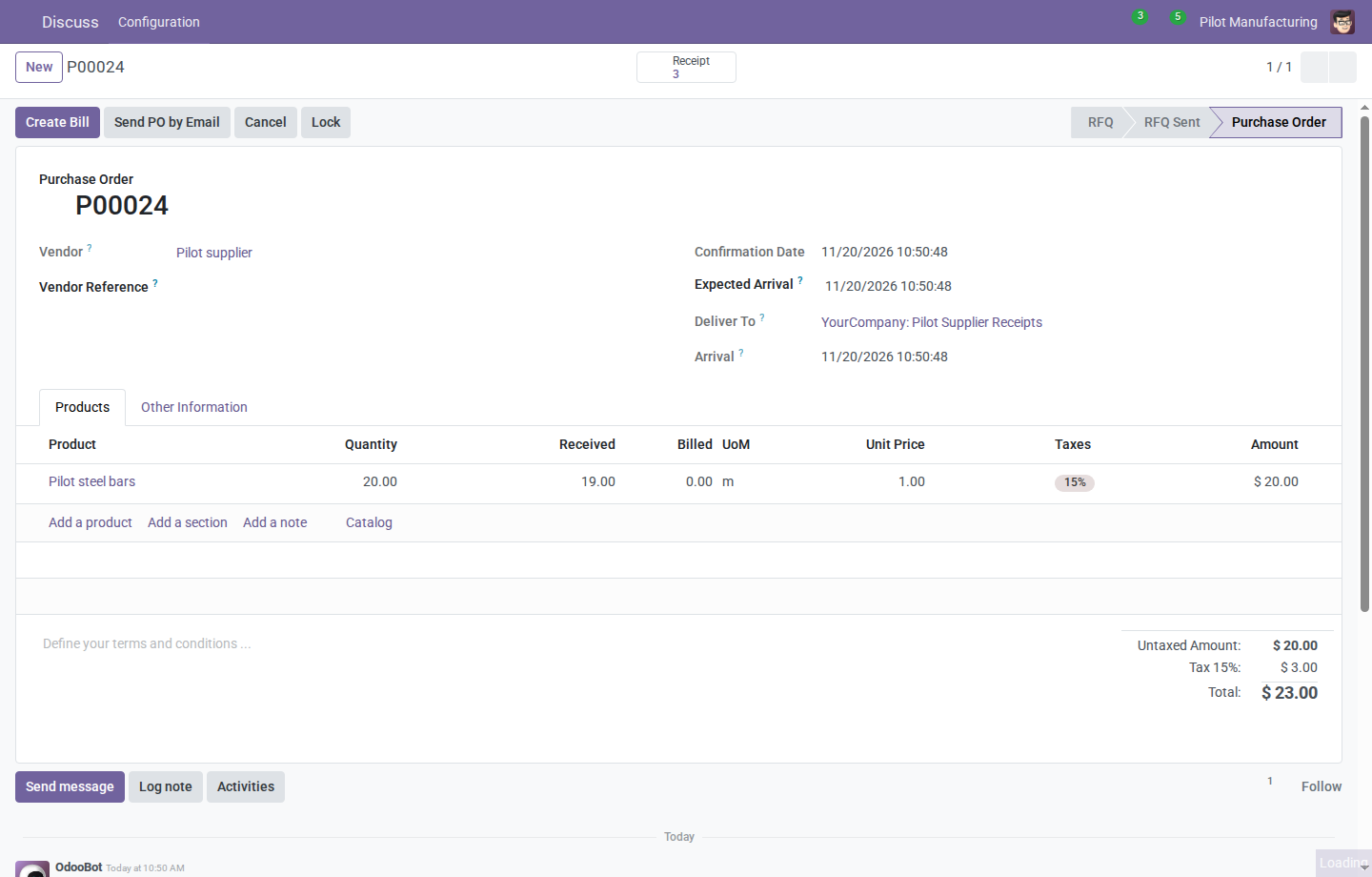
On purchase order P00024, the Receipt button at the top opens three linked transfers, including the receipt for the remaining quantity and the supplier return.
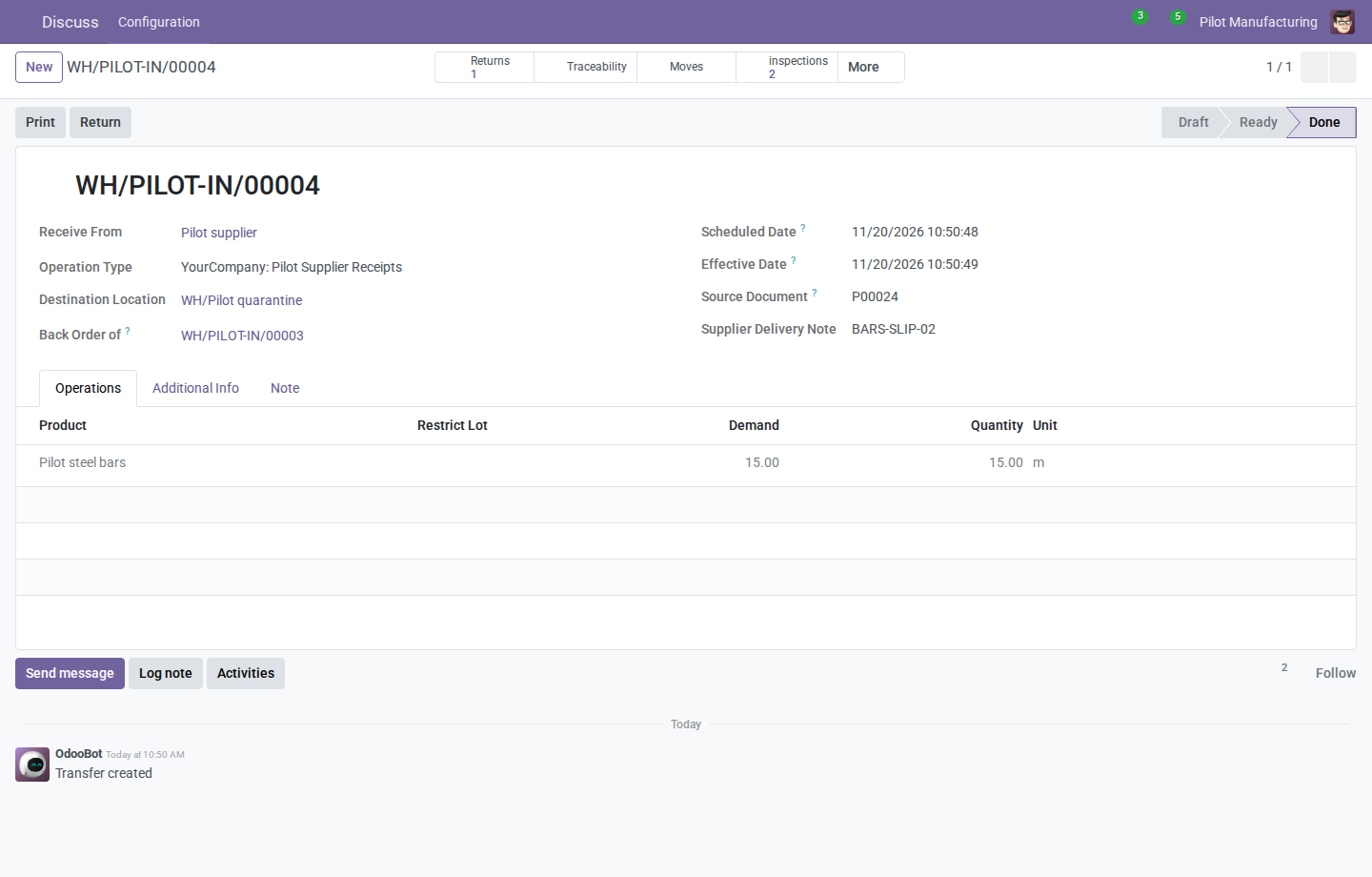
A validated supplier receipt with its delivery-note reference.
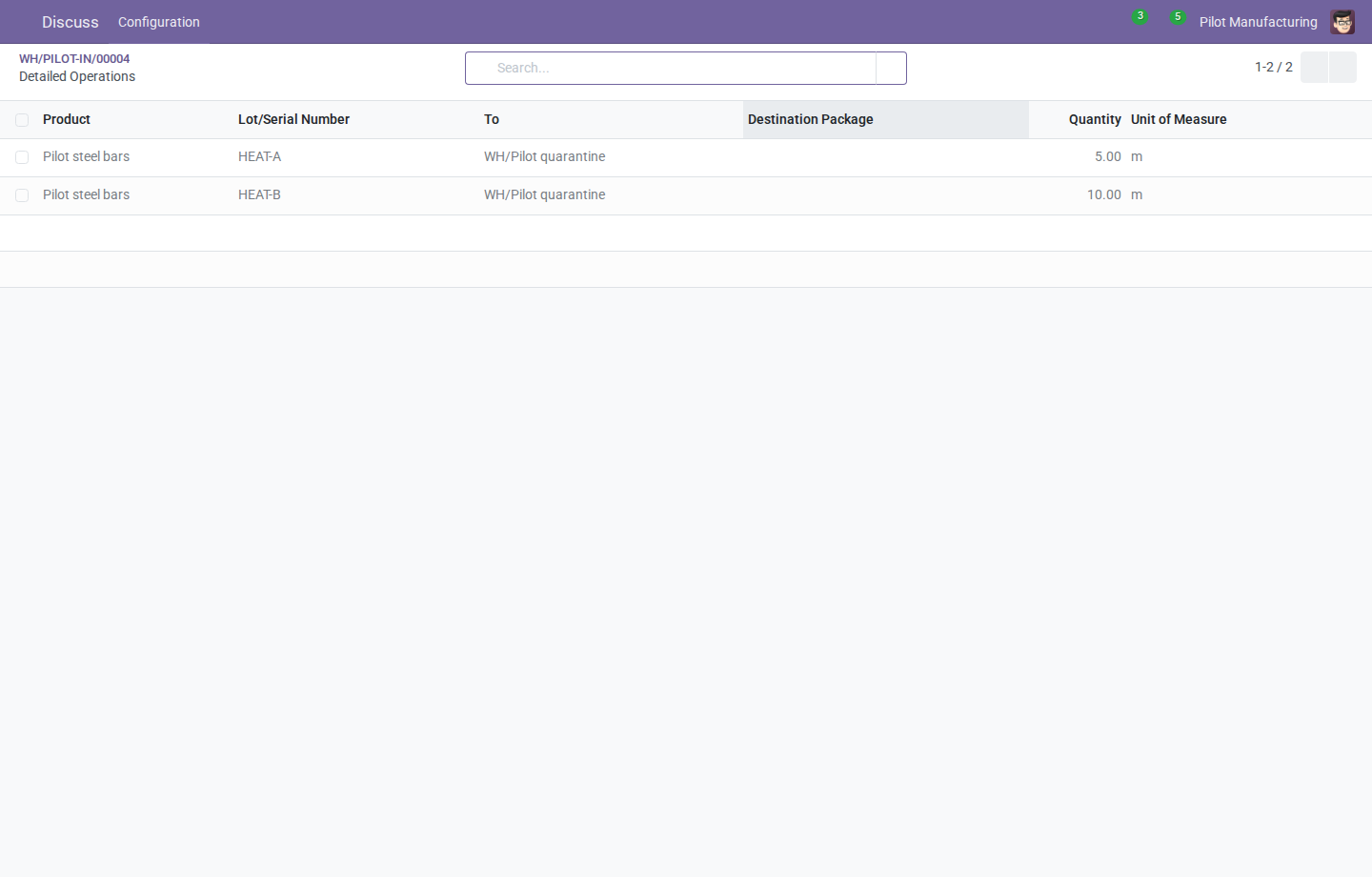
The second receipt records 5 m of steel bars from lot HEAT-A and 10 m from lot HEAT-B on separate rows. Both lots go into Pilot quarantine.
2. Inspect and release each heat
In Inventory → Products → Lots/Serial Numbers, open each received heat and attach its Mill Certificate. Verify that the product and heat match the certificate. On the receipt, open Inspections, enter the test result for the matching heat, and confirm it. Repeat for every receipt of that heat.
The quality manager opens an internal transfer from quarantine to usable stock and records the approved lots and quantities in detailed operations. For packed material, use Pick From to select stock from the correct lot and source package. Select the Destination Package if the released material will remain packed. Validate the transfer to make the released quantities available. Leave material with failed or incomplete inspections in quarantine.
To pack or repack material on hold, create an internal transfer with the same quarantine location as source and destination. Enter the lot and quantity. If the material is already packed, use Pick From to select stock from the existing package. Select or create the new Destination Package and validate. To empty a whole package, open it and click Unpack. For a partial unpack, use an internal transfer for the selected quantity and leave the Destination Package empty. In-place packaging changes keep the material on hold.
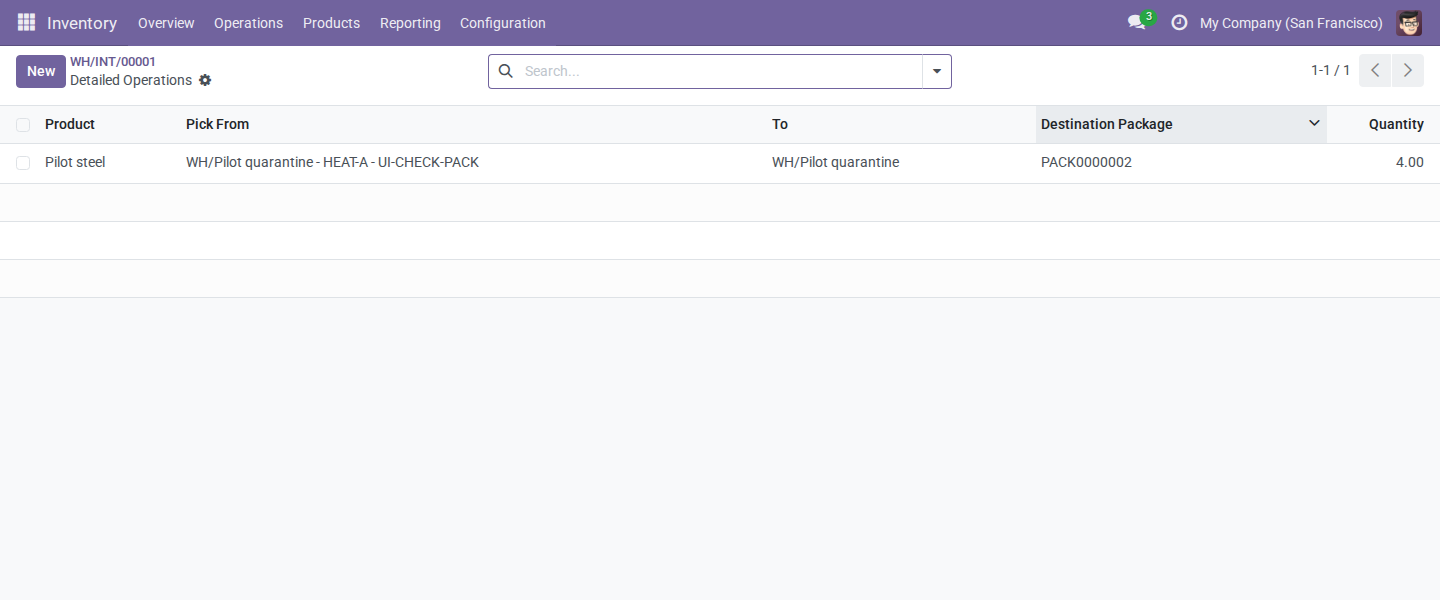
On the editable transfer, use Pick From to select lot HEAT-A in source package UI-CHECK-PACK. Under Destination Package, select PACK0000002 to receive the material.
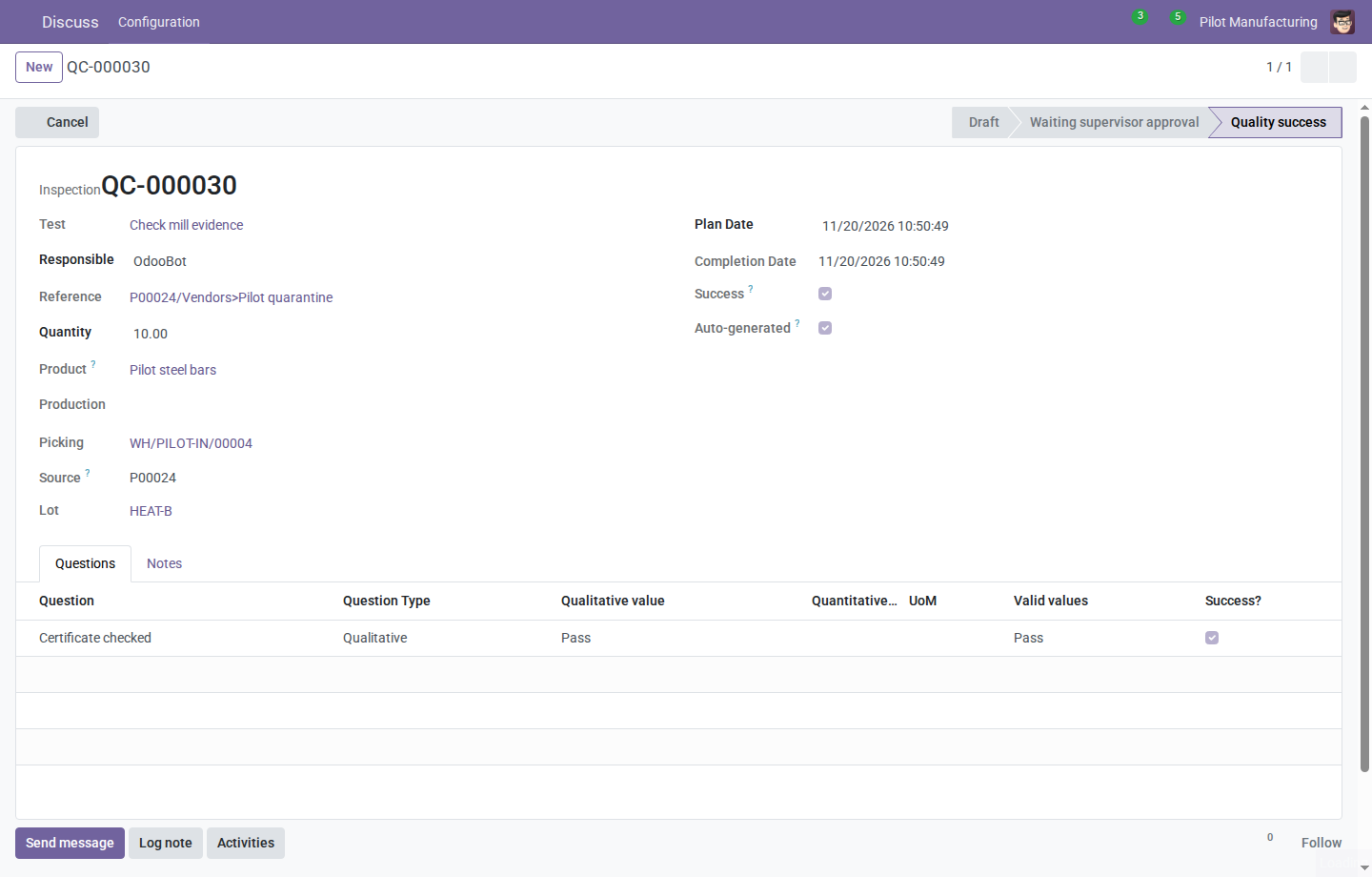
The receipt inspection identifies HEAT-B in the Lot field. The certificate check records Pass, and the inspection status is Quality success.
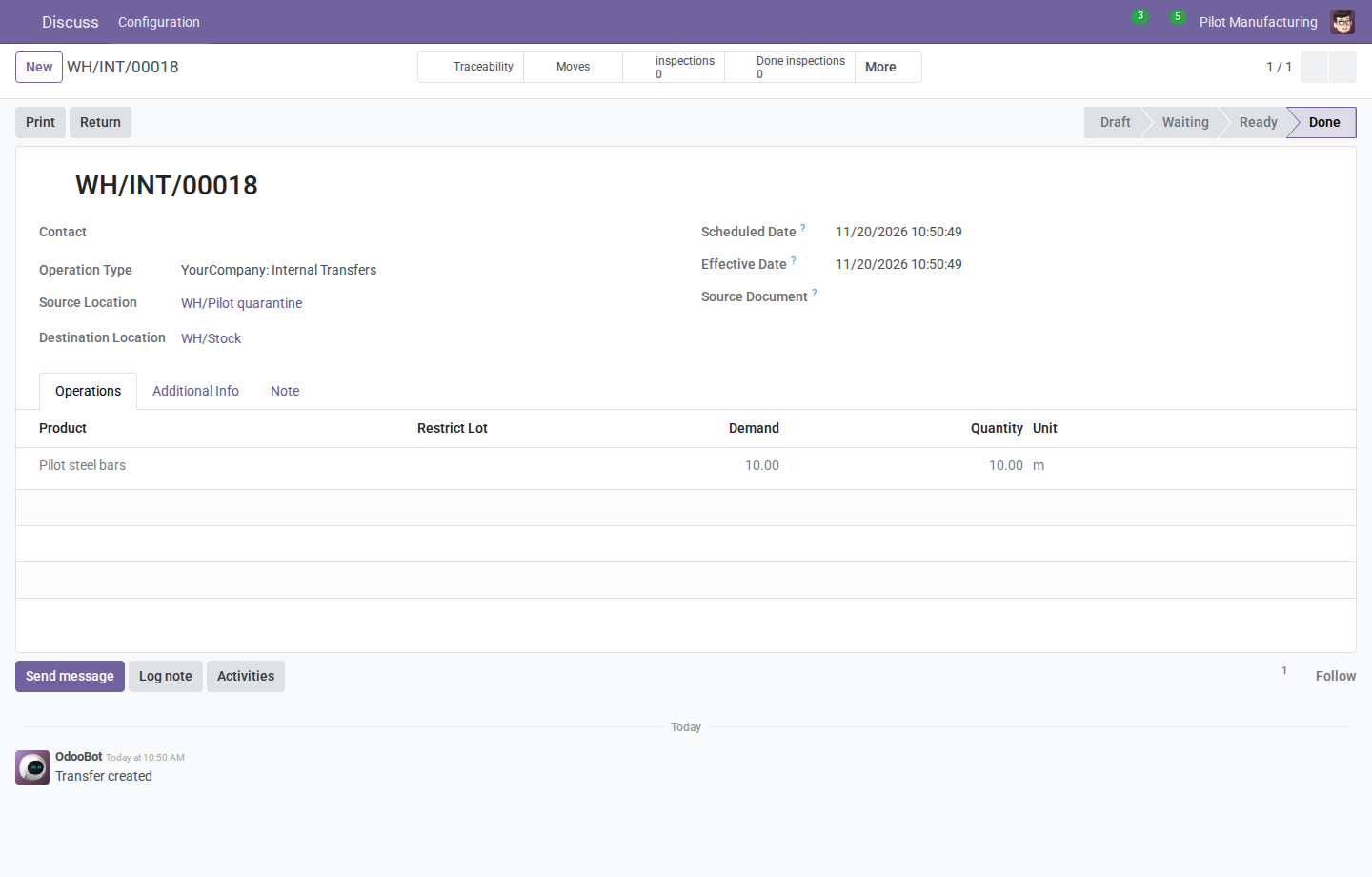
The completed release transfer moves 10 m of steel bars from the approved lot out of WH/Pilot quarantine and into usable stock at WH/Stock.
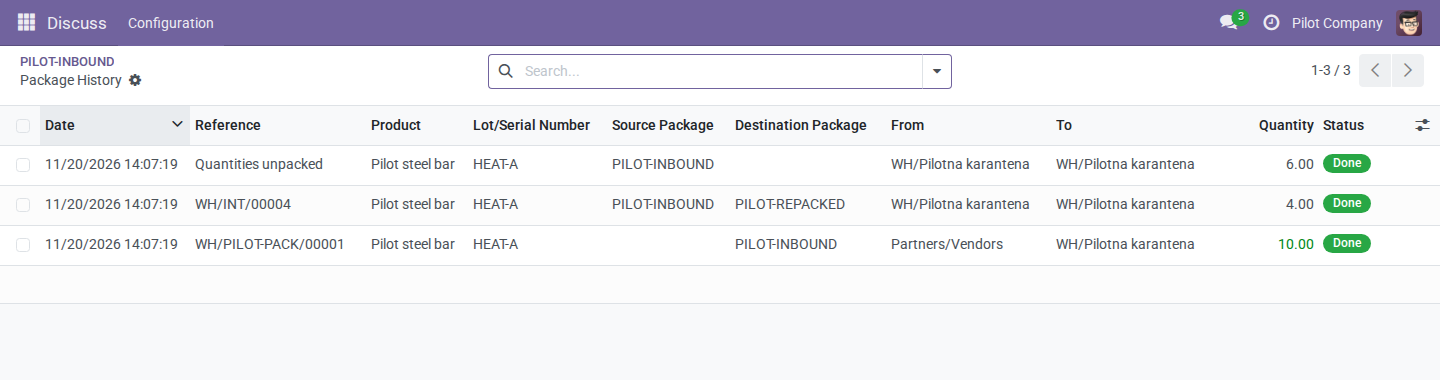
Read this Package History example from bottom to top. The receipt put 10 m into PILOT-INBOUND. The repack moved 4 m from that Source Package to PILOT-REPACKED as the Destination Package. The final row shows 6 m unpacked, so Destination Package is empty. Both packaging changes took place at the same quarantine location.
3. Manufacture and assign a finished lot
Open Manufacturing → Operations → Manufacturing Orders. Select the
finished product, BoM, and planned quantity, then confirm. Generate a
Lot/Serial Number for the finished batch. In Components, open
detailed operations and enter the actual heat and length consumed in metres.
For example, with a BoM of 2 m of steel bar per shaft, record 4 m from
HEAT-A for an order that produces two shafts. If the component is packed,
use Pick From to select the stock entry for the actual lot and package.
If using several packages of the same heat, enter a separate row for each
package used.
When the heat changes, complete the current batch and create a backorder for the unfinished quantity. On that order, generate a fresh finished lot and record the heat actually used.
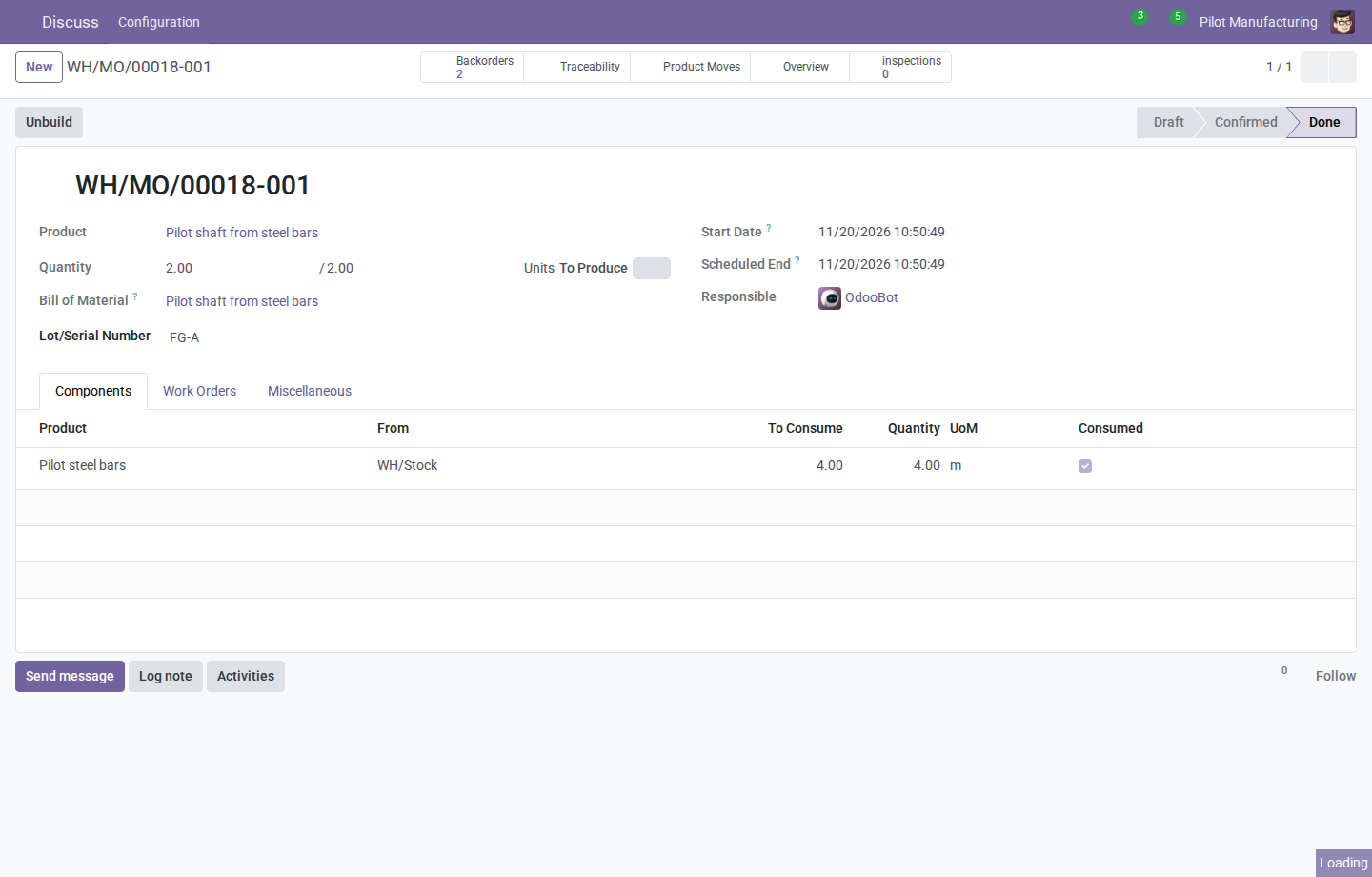
The completed manufacturing order shows two shafts in finished lot FG-A and 4 m of steel bars consumed. Open Traceability to see that the steel came from heat HEAT-A.
4. Pack, deliver, and invoice
Confirm the sales order and open Delivery. In detailed operations, record the actual finished lot and quantity. If finished goods are already packed, use Pick From to select stock from that package. Select the same package under Destination Package if you ship it intact, or use Put in Pack on the rows going into a new shipping package. Check the physical contents before validating. Use one finished lot per package during the pilot.
To pack finished goods into stock before shipment, post a same-location internal transfer with the finished lot and the new Destination Package. On the delivery, use Pick From to select stock from that package.
Validate the shipment and create a backorder for any undelivered quantity. Repeat packing and validation for the next shipment. Use Print → Delivery Slip on the validated transfer.
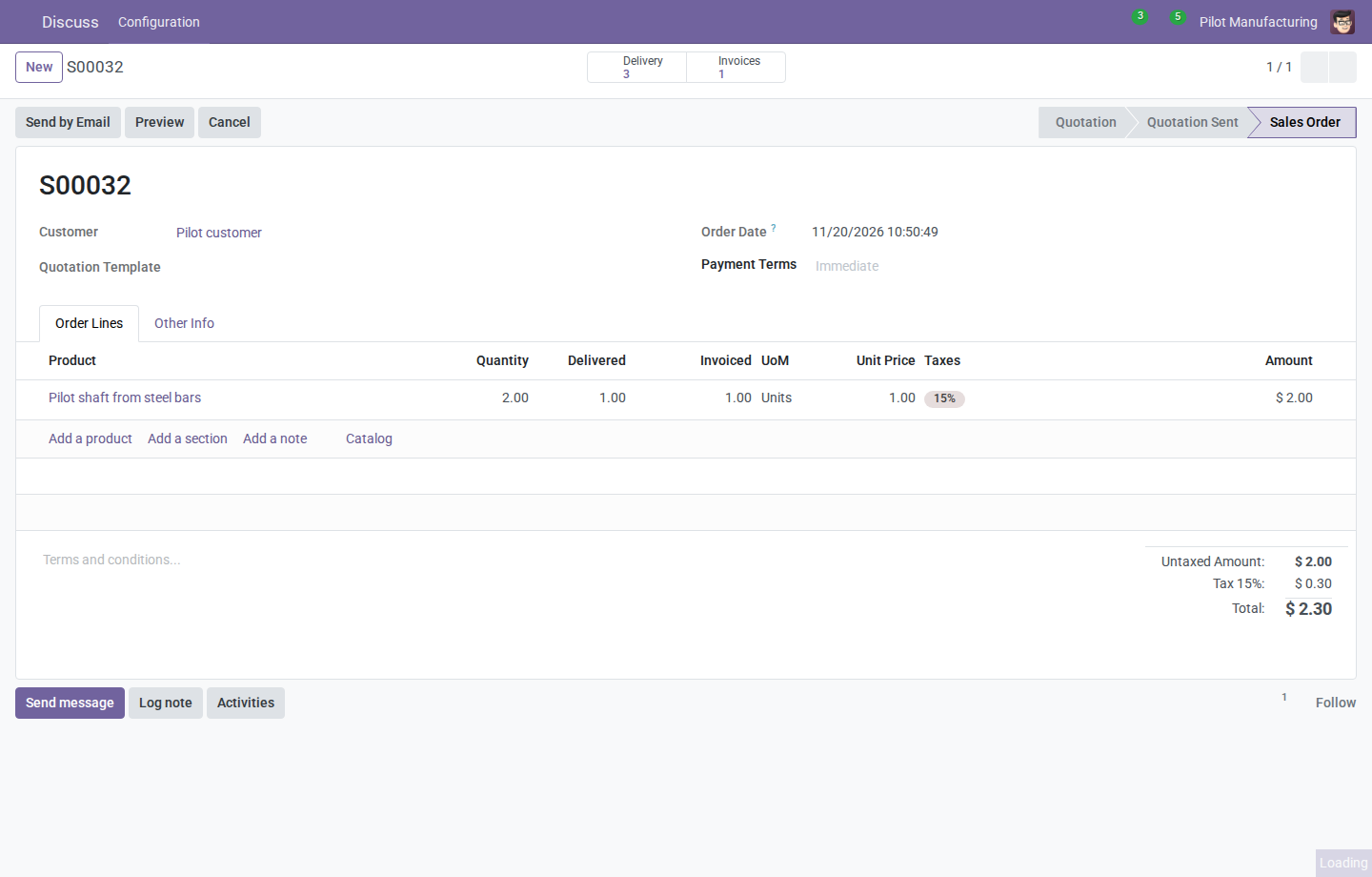
On sales order S00032, the Delivery button at the top shows three linked transfers. Click it and open the delivery for the shipment you want to check.
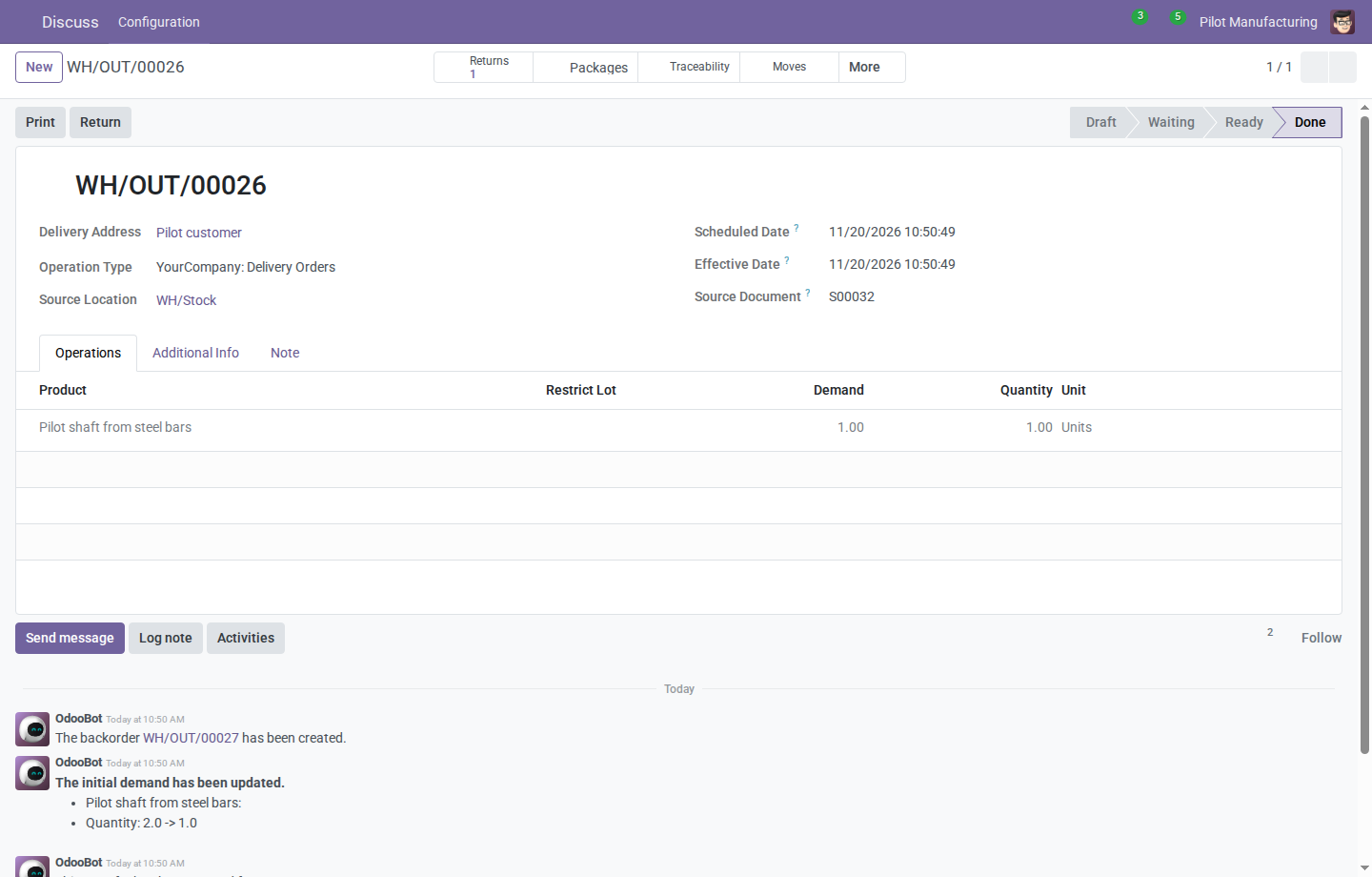
Completed delivery WH/OUT/00026 records one shaft shipped. Source Document shows S00032, the sales order for this shipment. Open Moves to check the finished lot and shipping package.
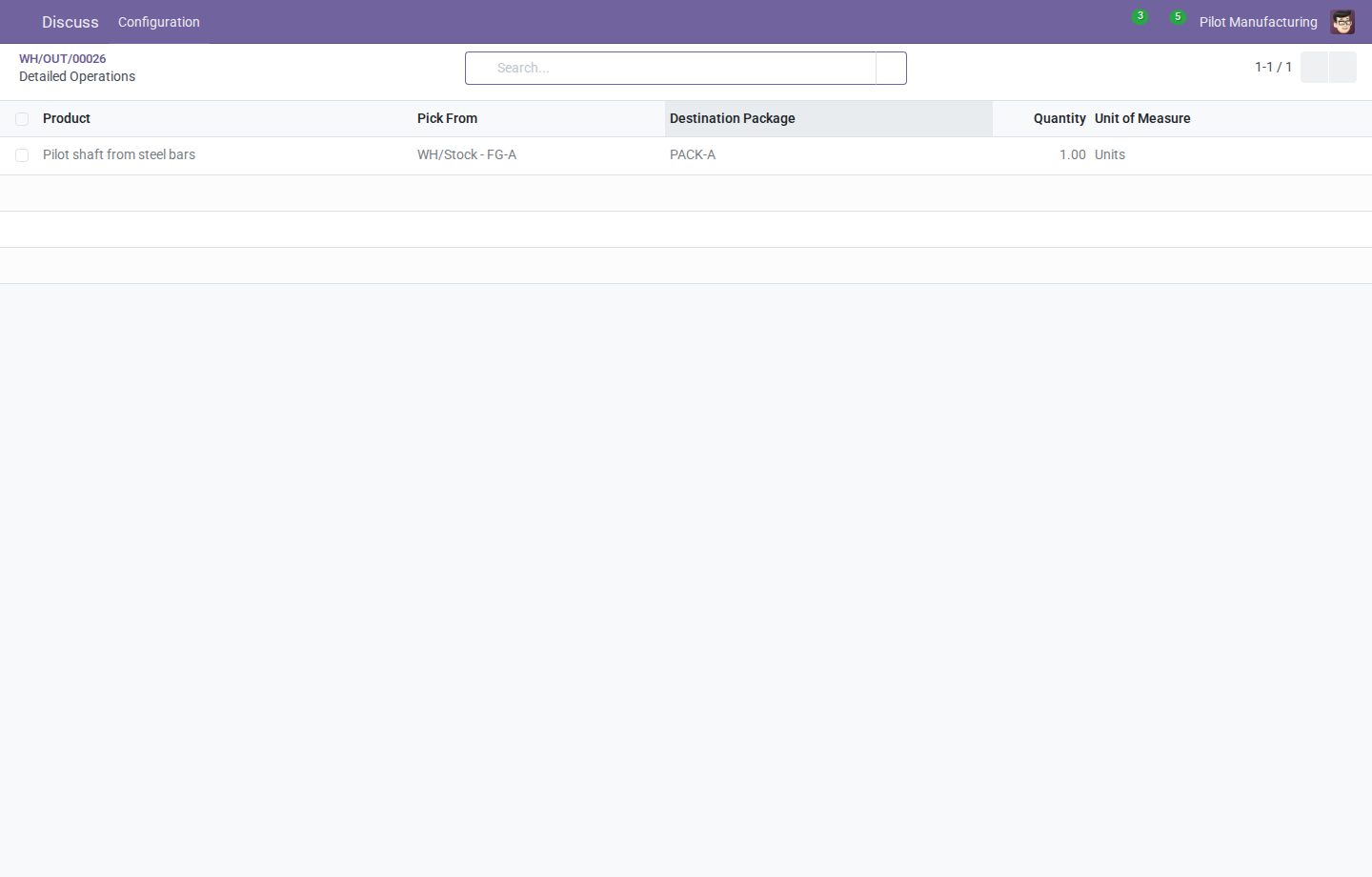
The delivery row records one shaft shipped from finished lot FG-A. Pick From shows the lot, Quantity shows 1.00, and Destination Package shows PACK-A.
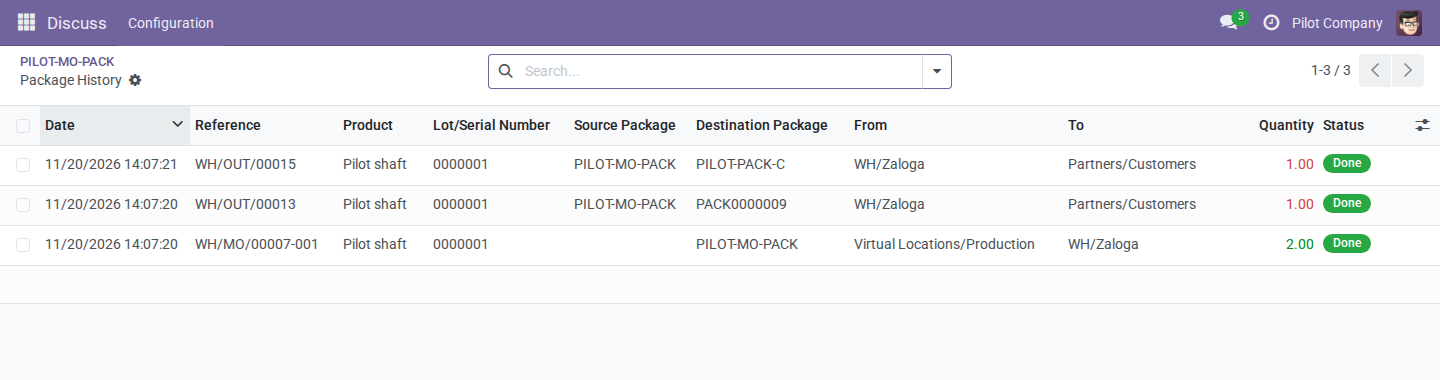
The production row at the bottom shows two shafts going into PILOT-MO-PACK as the Destination Package. On the two shipment rows above it, PILOT-MO-PACK is the Source Package. Each shipment takes one shaft into a different Destination Package.
Invoice a partial delivery
With delivered-quantity invoicing, create the invoice from the sales order after validating the first shipment. Check that Invoice Lines lists only the quantity shipped so far, then post the invoice. If lot printing is enabled, open the posted invoice print preview and verify the finished lot and quantity. For pilot invoices, lot details are recorded at posting so reprints retain the same lots after a return.
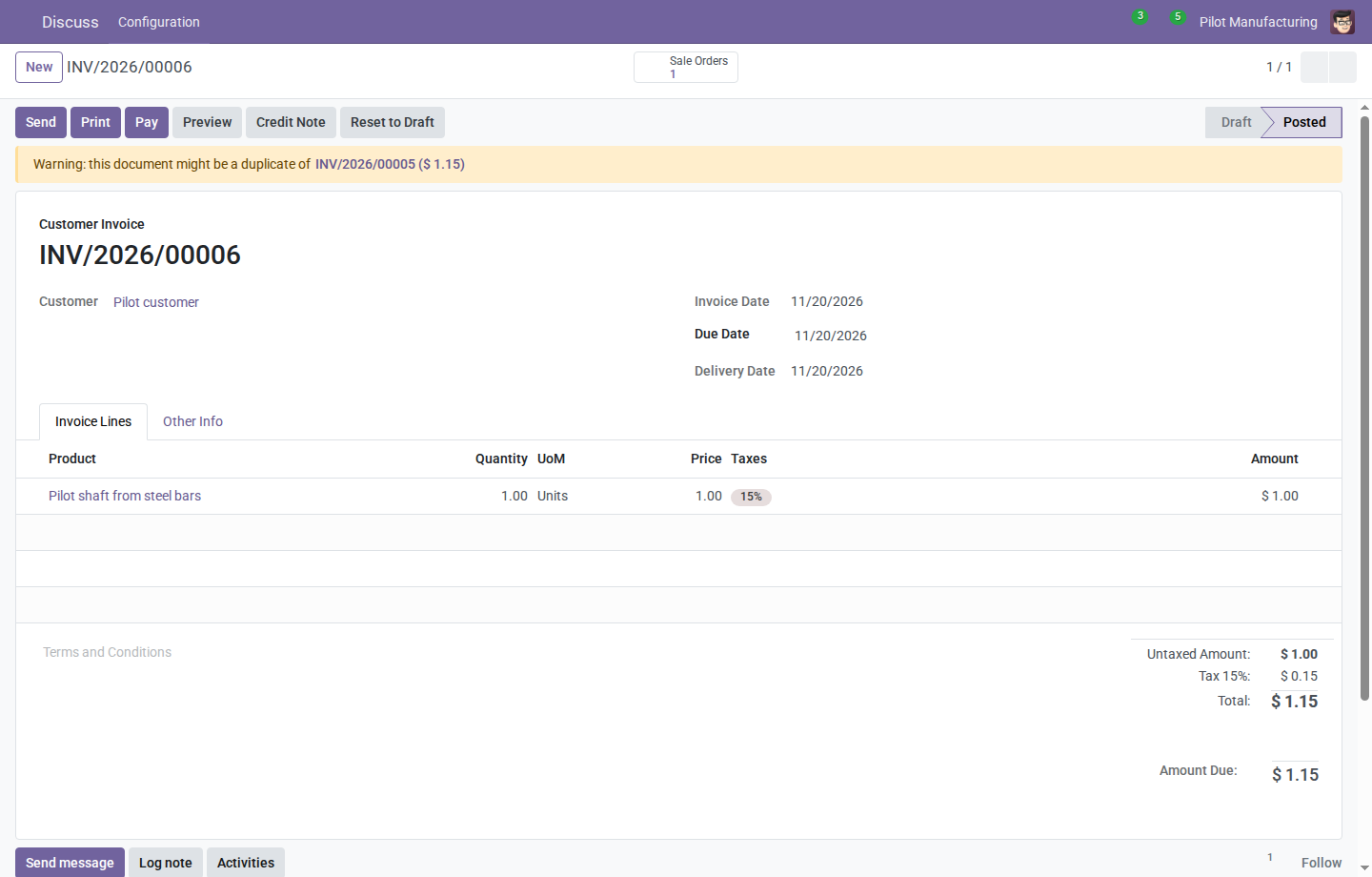
The invoice lines show one shaft billed for the first partial shipment. With lot printing enabled, the posted invoice preview lists the finished lot FG-A for that shaft.
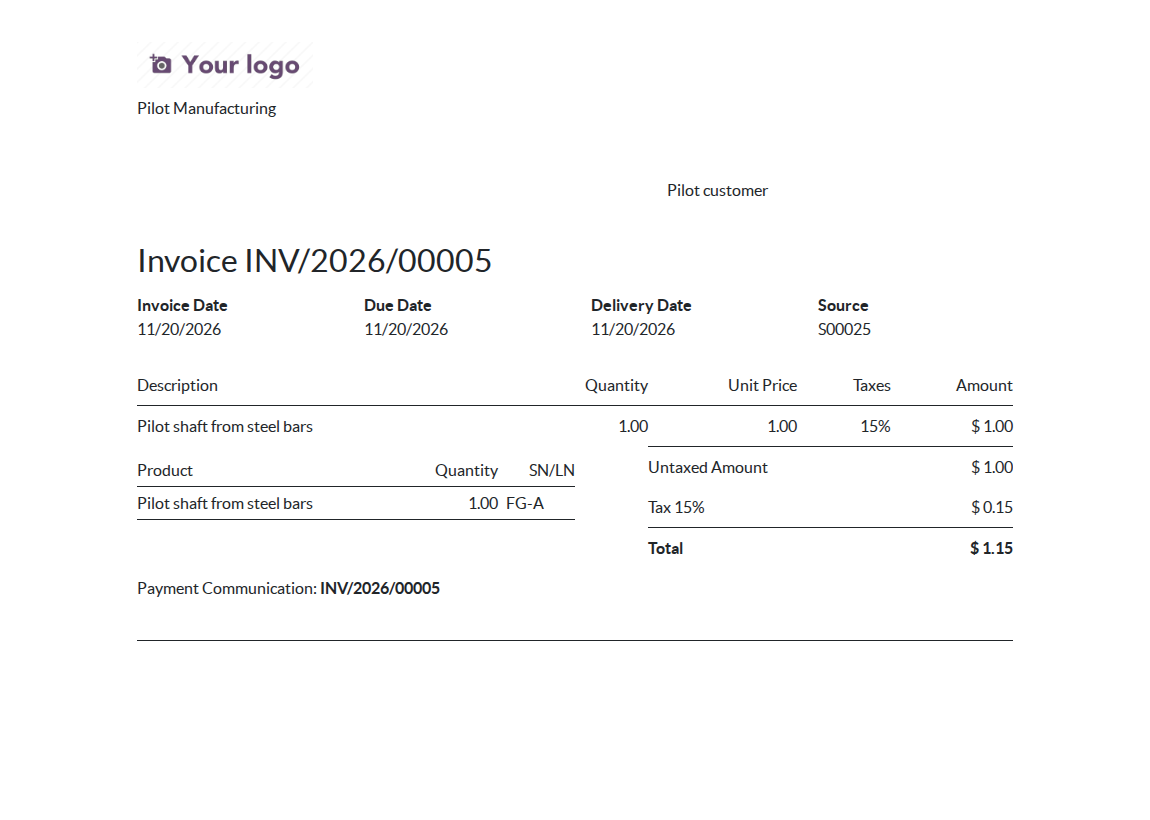
This posted preview shows a separate partial invoice for one shaft. The lot table below the invoice line shows the same quantity and identifies the finished lot as FG-A.
5. Post returns, scrap, and repacking
- Customer return. On the original delivery, click Return. Verify the original finished lot and returned quantity, create the return, and validate it when the goods arrive. If the returned goods are packed, record the actual Destination Package on the return before validating. Check the updated delivered quantity on the sales order.
- Supplier return. Use Return on the original receipt. Confirm the original heat and rejected quantity. If the rejected goods are packed, use Pick From to select stock from the correct package before a quality manager validates the return.
- Scrap. Open Inventory → Operations → Scrap. Enter the product, location, lot, and quantity. If the material is packed, select it in the Package field. A quality manager validates scrap from quarantine. Open the posted scrap move to verify the heat.
- Repack. On a new internal transfer, open detailed operations. Enter the source location, lot, and quantity. If the goods are already packed, use Pick From to select stock from the existing package. Select the new Destination Package and validate. Check the new package contents. The original delivery retains the shipped package.
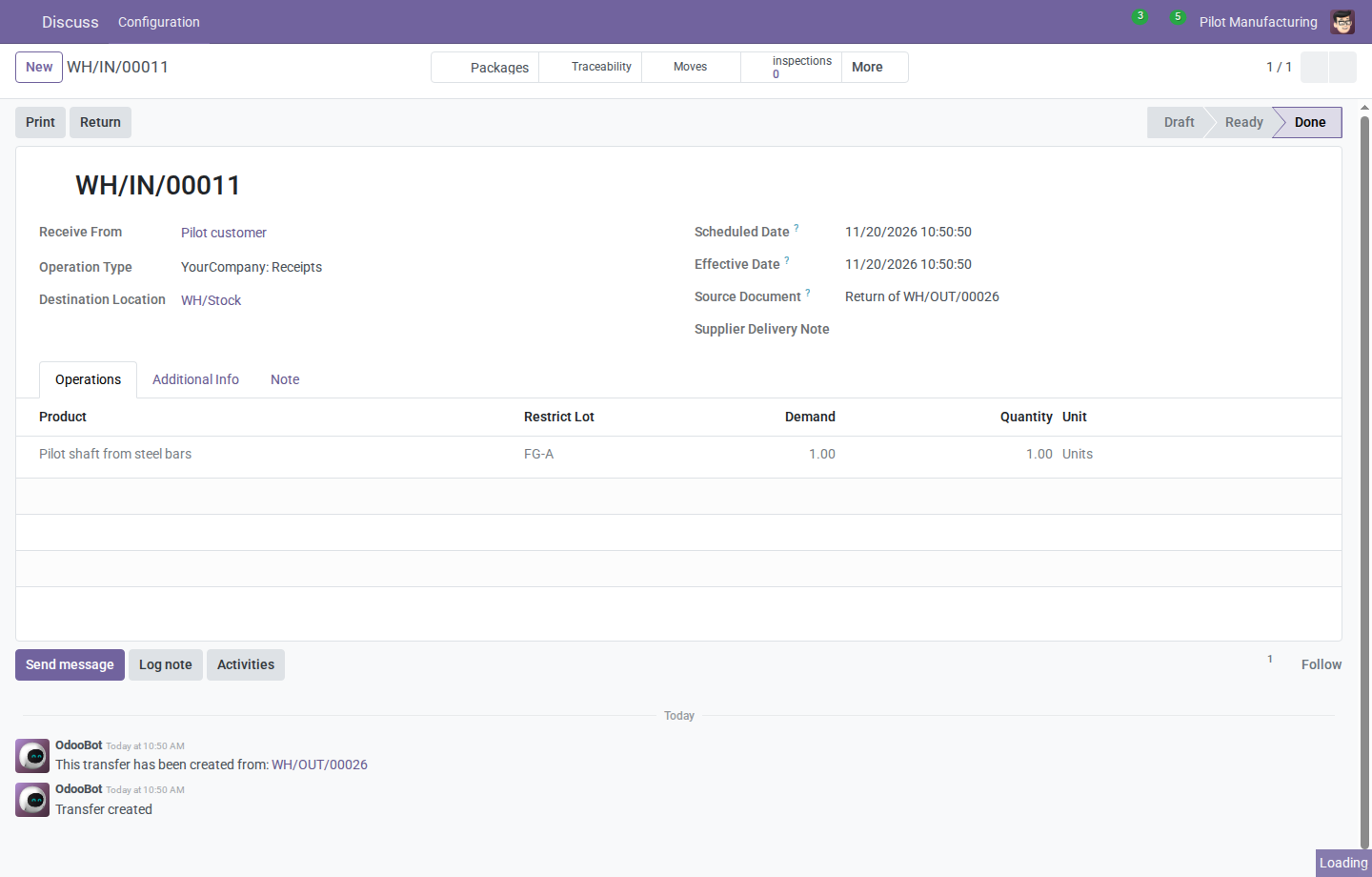
On customer return WH/IN/00011, Source Document reads Return of WH/OUT/00026, identifying the original delivery. The return records one shaft from finished lot FG-A.
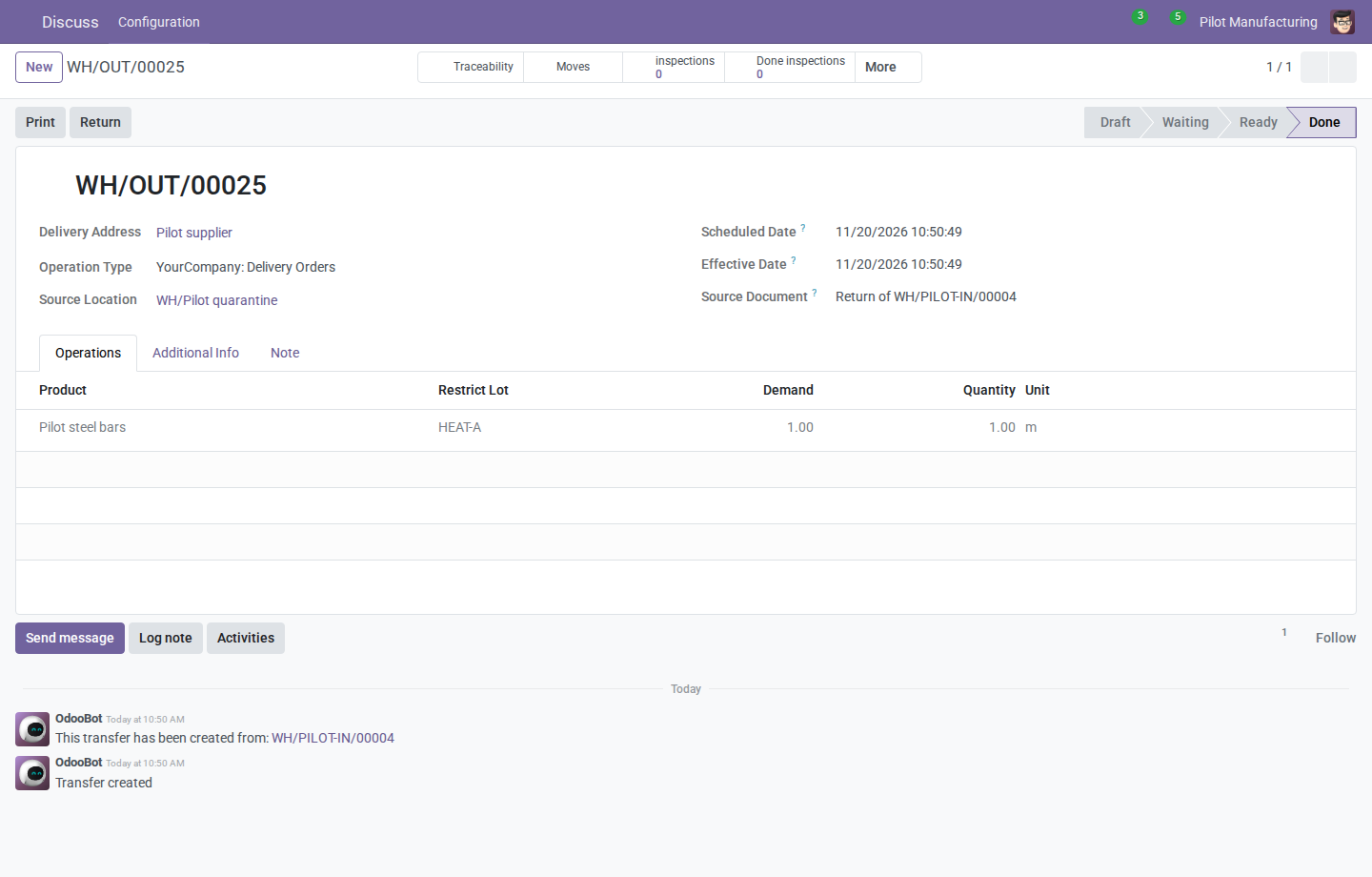
On supplier return WH/OUT/00025, Source Document reads Return of WH/PILOT-IN/00004, identifying the original receipt. The return sends 1 m of steel bars from lot HEAT-A back to the supplier.
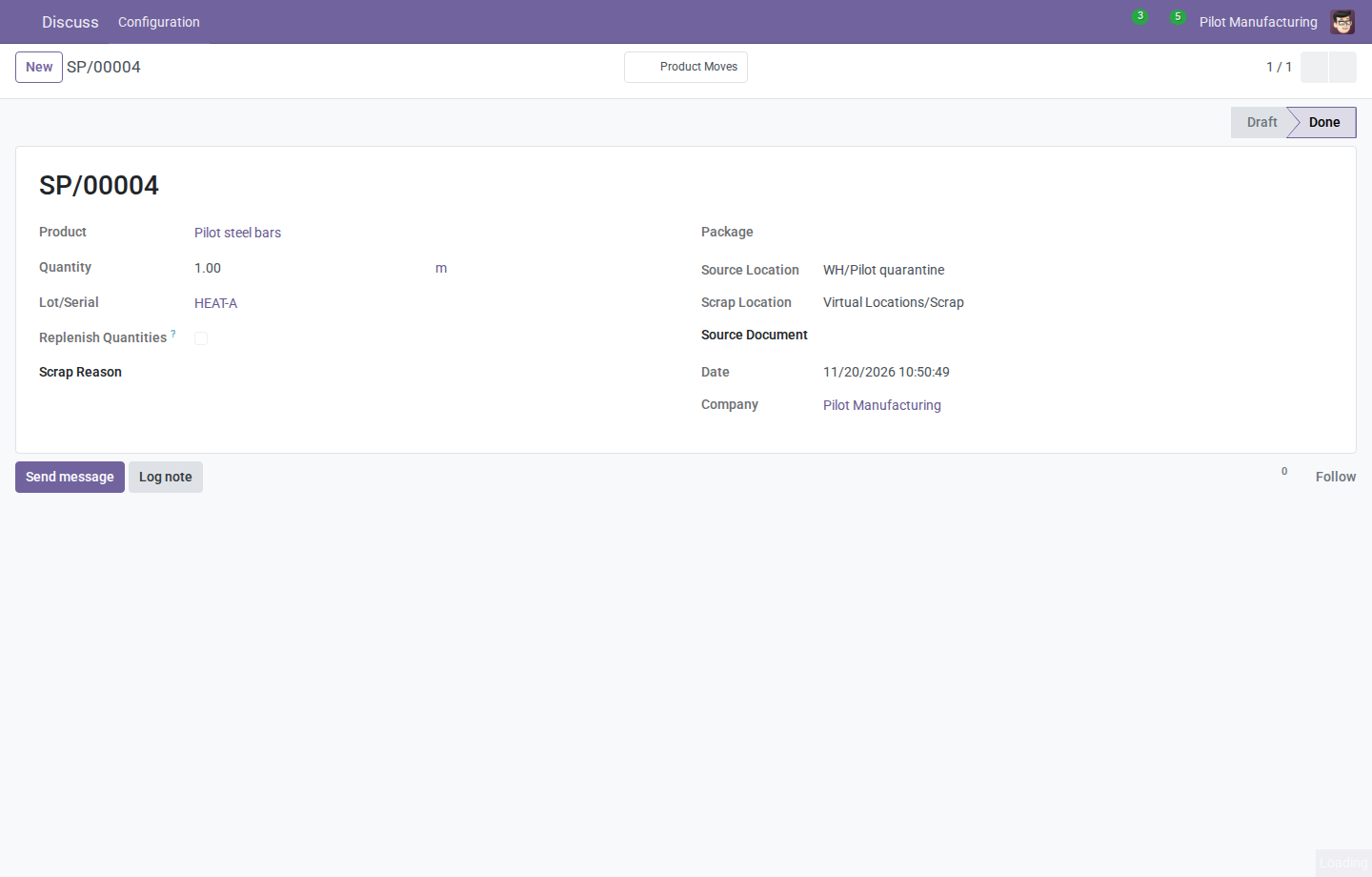
Scrap operation SP/00004 removes 1 m of steel bars from heat HEAT-A. The Source Location is WH/Pilot quarantine, and the Scrap Location is Virtual Locations/Scrap.
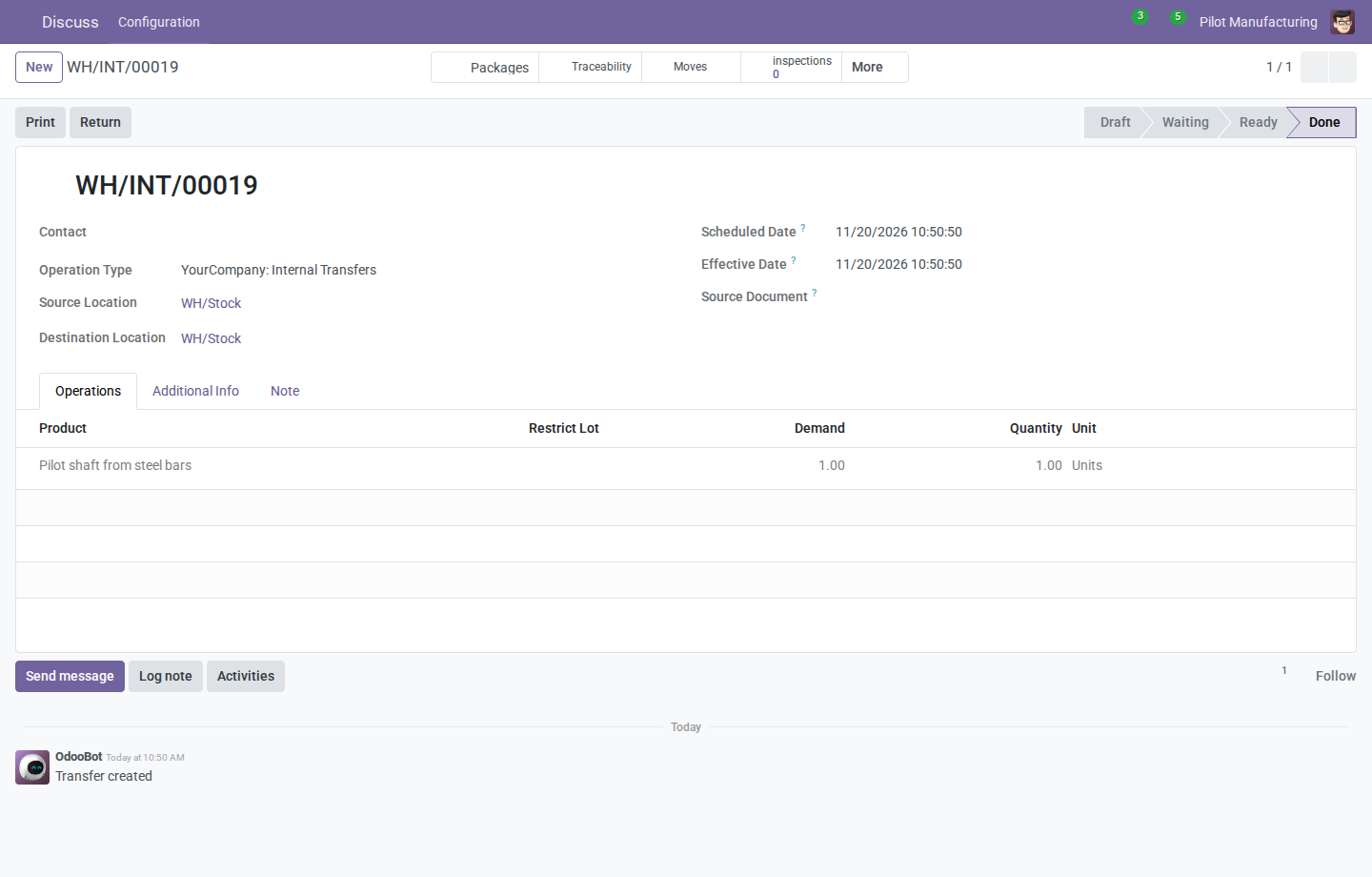
Completed internal transfer WH/INT/00019 records the repacking of one returned shaft. Source Location and Destination Location are both WH/Stock. Open Moves to check the lot and the two package references.
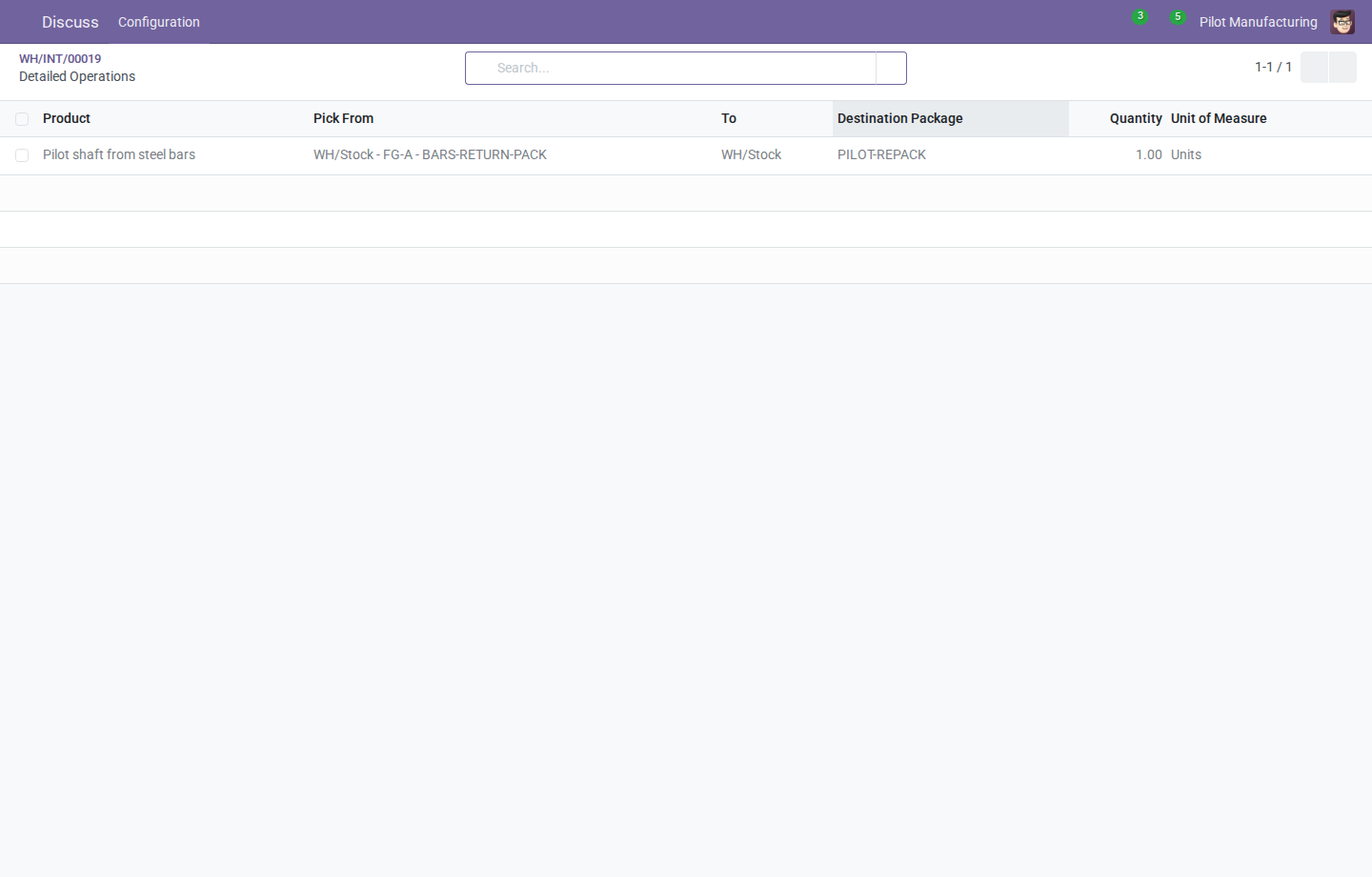
Pick From shows one returned shaft from lot FG-A in BARS-RETURN-PACK. The transfer moves it into PILOT-REPACK, shown under Destination Package, and keeps the same lot FG-A.
6. Trace a package back to its supplier
From a validated delivery, open detailed operations and note the reference in Destination Package. In Inventory → Products → Packages, open that package and click Package History. Compare Source Package and Destination Package on each posted row. The same reference in both columns means the package moved intact. A source package with an empty destination package means the quantity was unpacked. If both columns show different packages, open the other package to follow the repack. The posted rows remain available even when the package is empty.
Find the finished lot on the delivery row. Open the lot and choose Traceability. Expand the manufacturing entry to identify the consumed heat. Follow the stock release and receipt moves to find the PO and supplier slip numbers. Open the input lot for the mill certificate. One heat may have arrived on several receipts.
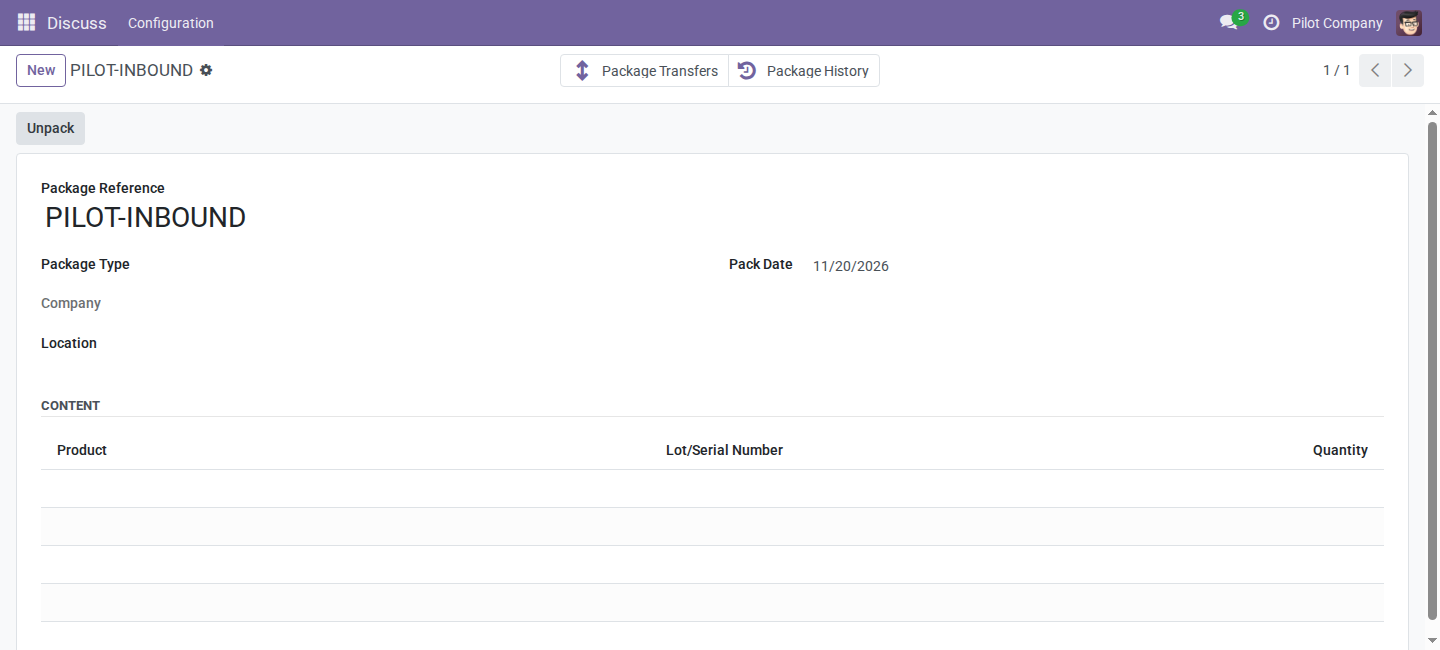
After unpacking, open the empty package and click Package History at the top, next to Package Transfers. The Content table is empty, but the posted movements are still available.
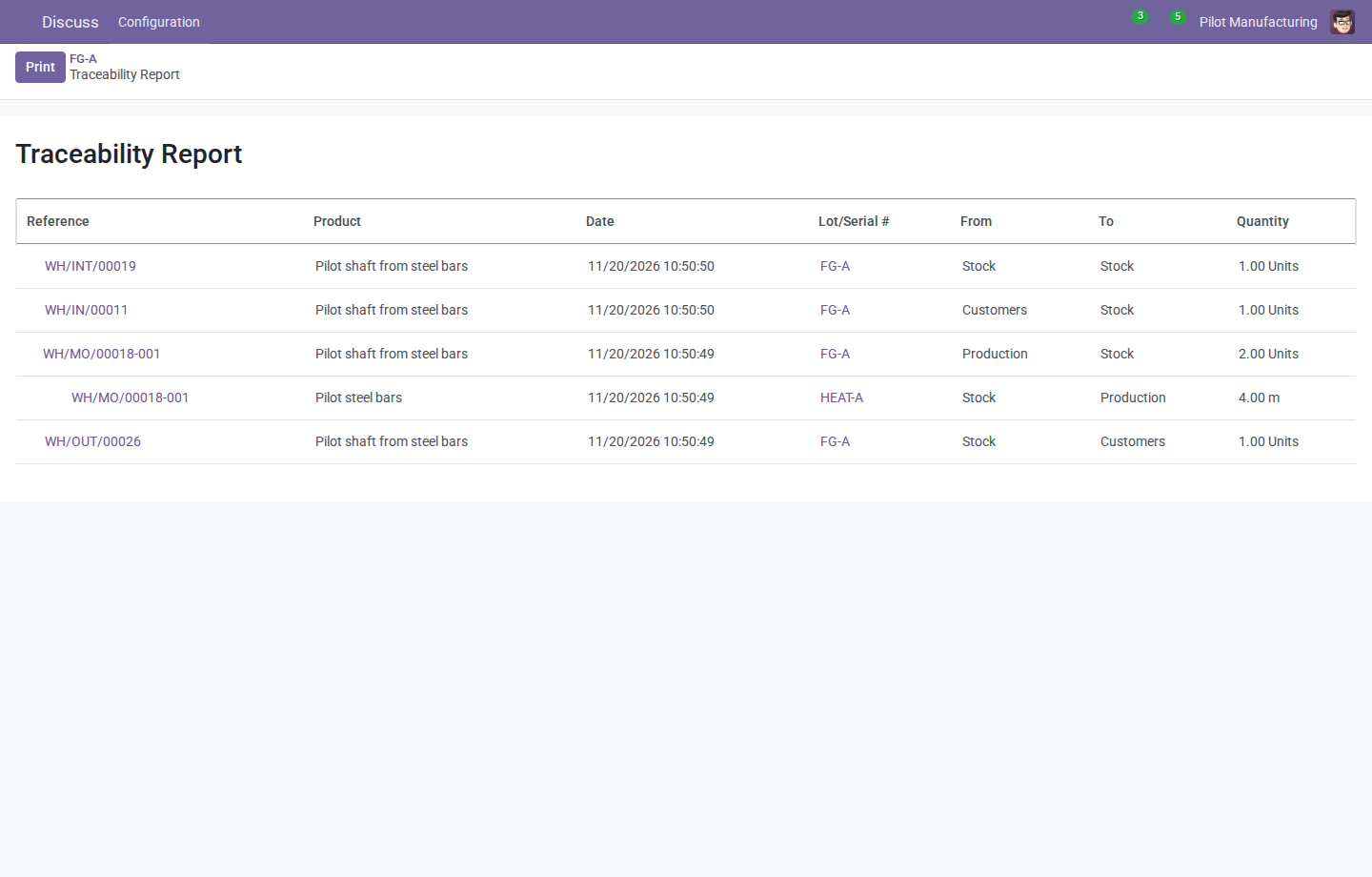
In Traceability for finished lot FG-A, expand the manufacturing entry to see the 4 m of steel bars consumed from HEAT-A. Follow the input lot's stock movements to its release transfer and supplier receipt.
7. Trace a heat forward to customers
Open the input lot in Inventory → Products → Lots/Serial Numbers. Use Location to see remaining stock and Traceability to see the batches that used the heat. Select Customer Deliveries and inspect each shipment for customer, lot, quantity, and package. Review the linked customer returns to determine how much is still with each customer. Use Transfers to see supplier returns as part of the general transfer history.
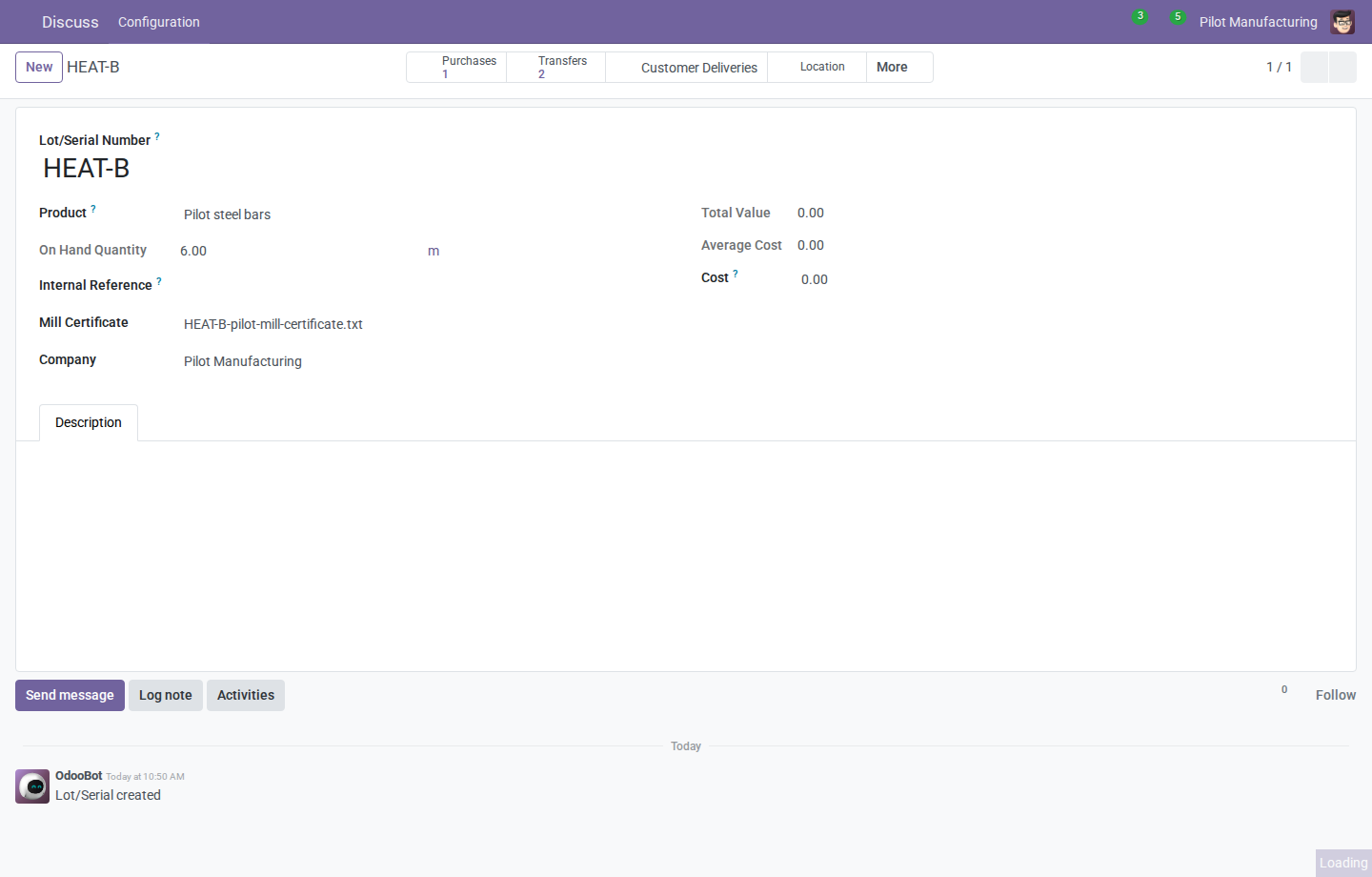
On input lot HEAT-B, the supplier's certificate is attached in Mill Certificate. Click Customer Deliveries at the top of the lot form to see the shipments affected by this heat.
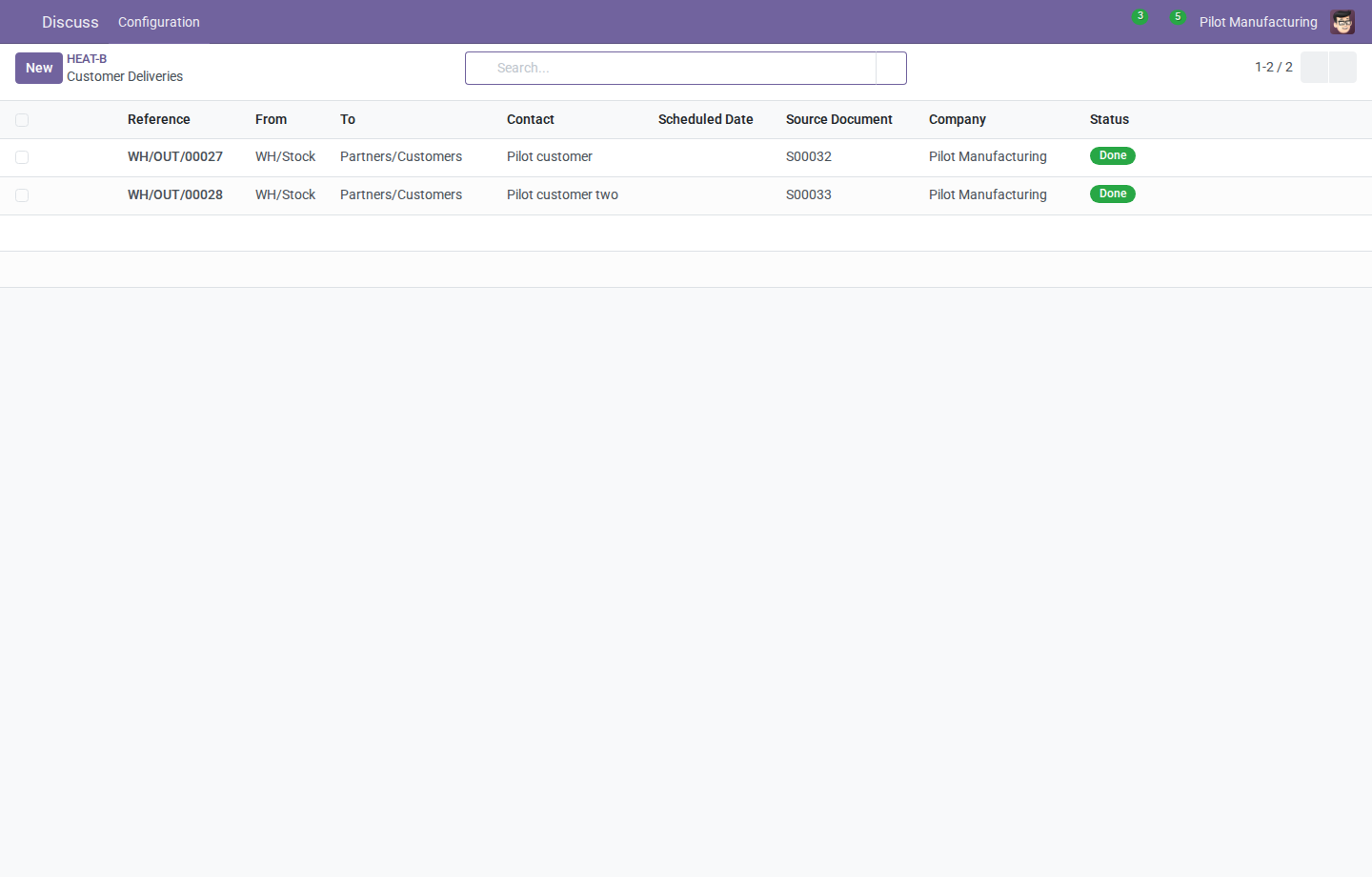
Customer Deliveries for heat HEAT-B lists two affected shipments, WH/OUT/00027 and WH/OUT/00028. The Contact column identifies the customer for each shipment.